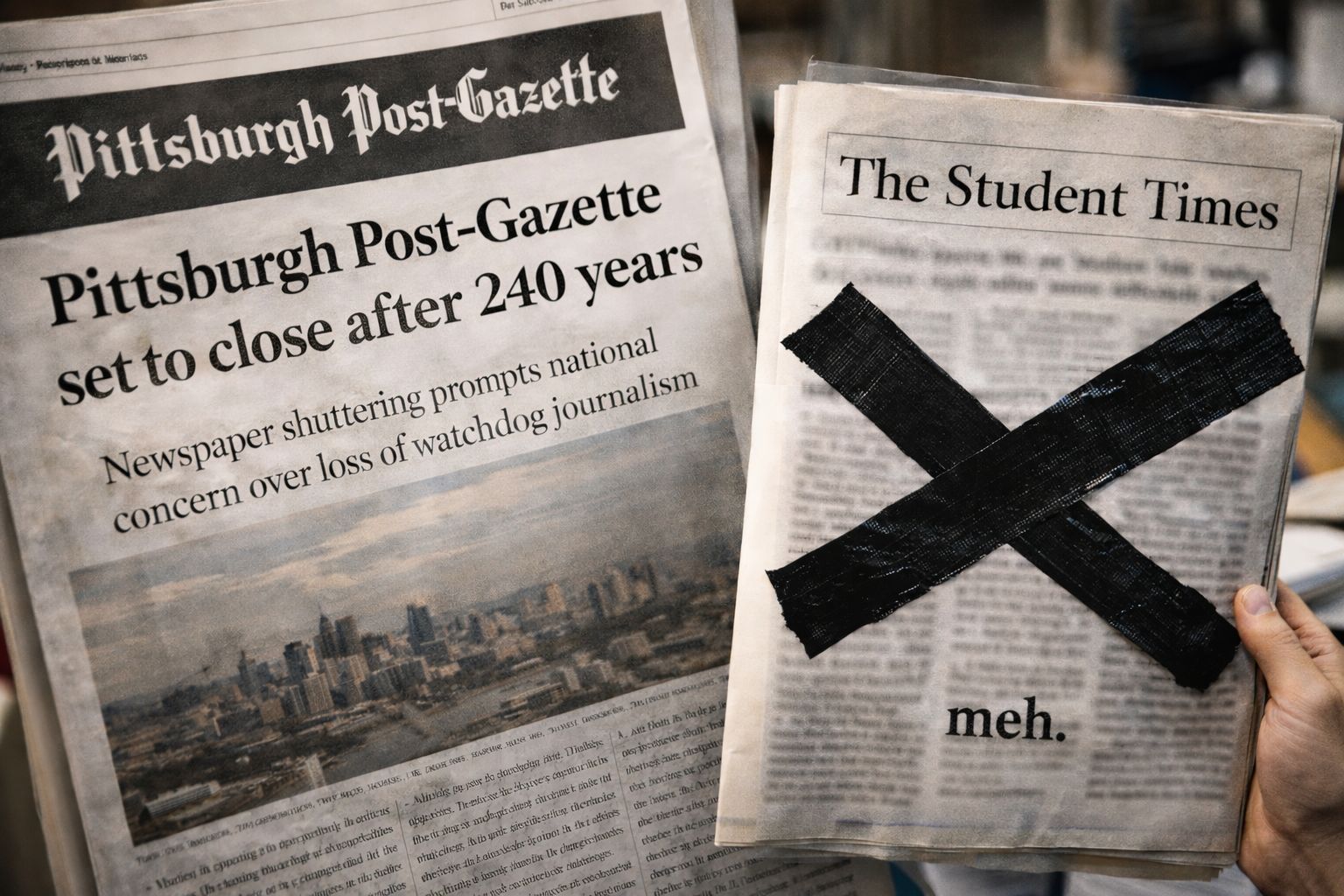
The Pittsburgh Post-Gazette, which traces its roots to 1786, will close May 3, 2026. That news lands like a gut punch. A once-venerable, award-winning newsroom goes dark, and another major American city loses a daily watchdog.
Major press outlets have responded with extensive coverage, and rightfully so. As journalism collapses, one masthead at a time, democracy fades with it. But what enrages me is this: Why does the mainstream media fixate on the crisis of professional journalism while remaining largely silent about the absence (and censorship) of student journalism?
This discrepancy smacks of hypocrisy. Student publications now cover town meetings and power struggles that major outlets have walked away from — yet when student journalists later need mainstream media’s support, they are largely ignored. This hurts. A lot.
To understand how often schools silence student reporting, start with the Student Press Law Center. At no cost to student journalists or their advisers, SPLC answers panicked calls — including one from me when I incorrectly taught my students about copyright. The organization’s staff are heroes, who train advisers and editors, explain the law in plain English, and document censorship when administrators try to bury stories.
If student press freedom has a national memory, SPLC records it, even while responding to hundreds of requests for legal assistance each year. That record also includes states with New Voices protections, which further curb administrative censorship and retaliation for lawful reporting.
In fact, SPLC’s work reveals a pattern of conflicts, not just a handful of them. School leaders suppress student journalism for the same reasons powerful people always suppress journalism: to control the narrative, avoid embarrassment, and dodge accountability.
Consider these examples:
· University of Alabama (2025): Administrators closed two student-run magazines following disputes over their editorial direction, including coverage focused on women’s issues and Black student experiences. As SPLC’s Senior Legal Counsel Mike Hiestand said, “By shutting down only the magazines that primarily serve women and Black students — while leaving other publications alone — it looks a lot like [the university is] targeting a particular point of view.” The mainstream news industry, meanwhile, offered scant attention, though the Alabama Reflector, an independent outlet, deserves credit for trying to get the ball rolling.
· Mountain View High School (CA), 2024: Student journalists investigated allegations of student-on-student sexual harassment and later alleged the principal of “using her authority and position to exert enormous and unlawful pressure to significantly water down their in-depth investigative piece,” according to SPLC’s reporting of the complaint. School officials, for their part, characterized the actions as routine administrative decisions. Outside press-freedom circles, the controversy drew little national attention and received no sustained media coverage.
· Prosper High School (TX) (2018): District officials imposed prior review after coverage made them uncomfortable, requiring administrators to approve student work before publication. That policy does not educate; it controls. SPLC coverage warns us of what prior review does best: it chills reporting before it starts. Mainstream outlets, again, mostly kept quiet, aside from this story that ran in the Dallas Observer.
In each case, administrators tried to protect reputation and power. But the failure to cover such developments does not end at the schoolhouse door. When legacy outlets treat these incidents as niche education drama instead of press freedom emergencies, they help normalize the muzzling.
Silence has consequences.
It tells teenagers that the First Amendment, which adorns my classroom wall, comes with an age requirement. As a teacher of AP Government, American History, and Journalism, such trivializing is the last lesson I want my students to learn.
It tells student publication advisers that doing the right thing will cost them their jobs, especially in states without New Voices legislation, which provides enhanced protections.
And it tells administrators they can swat down scrutiny without paying a public price.
That dynamic makes the press complicit. I say that with no satisfaction. Journalism exists to defend press freedom wherever it is threatened — not just when it is convenient. That belief leaves me no choice but to speak, even when doing so carries a cost.
After calling out what I saw as unethical reporting by The Atlantic on private schools and AI in education, I stopped writing for the magazine. When I later tried to pitch stories again — including some on this very topic — there was only silence. Unfortunately, this silence is familiar to student journalists whose struggles for press freedom so often go uncovered.
And when that silence meets power inside schools, the consequences are real. Beyond the incredibly caring and supportive scholastic journalism community, where is the outrage over stifling the young reporter who verifies facts, writes carefully, and then watches an adult threaten the adviser, kill the story, or cut the program? Some call that “school order.” Students experience it as a civic lesson in fear.
At the same time, it would be dishonest to ignore the pressures reshaping the news industry itself. I first studied this calamity as a journalism student at Brandeis University in the early 2000s, and I still remember reading Ben Bagdikian’s The Media Monopoly in Professor Michael Socolow’s Introduction to Journalism class. That book laid out the very forces still defining the crisis years later: consolidation, commercial pressures, and the structural dynamics that would later enable platform dominance.
To say that legacy media need to face a reckoning is long overdue. It should ask, plainly: Have we made room for young journalists (especially student journalists), or have we treated their work as a feel-good sidebar? Have we welcomed their ideas about participation and trust or dismissed them as naïve? If the industry had amplified those voices instead of sidelining them, perhaps some of these venerable newspapers might have adapted before the lights went out.
It gives me no pleasure to write this, but student journalists have every right to feel betrayed as the press mourns its own demise, yet it whispers about censorship in schools. And if many students decide they won’t reward this industry by not choosing a career in journalism, I understand. When the old guard shrugs at the suppression of student press rights, it should not be surprising when the next generation walks away. The industry owns that outcome.
So, yes, grieve The Post-Gazette — and all of the other vanished “nearly 3,500 newspapers and more than 270,000 newspaper jobs since 2005,” according to the 2025 Medill State of Local News report on closures and expanding news deserts.
But if we want watchdog journalism to survive, the press must defend our watchdogs-in-training with the same urgency, the same volume, and the same persistence it now devotes to writing its own obituary.